
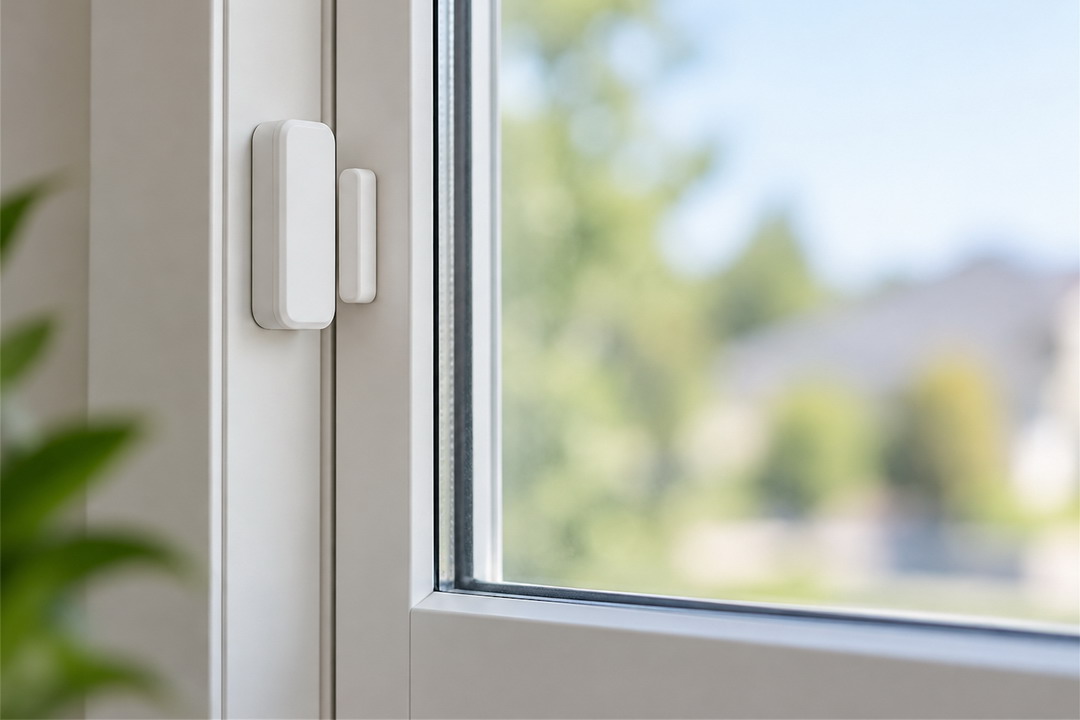
We expect the home security industry to keep pushing out high-tech devices powered with AI and other technologies. All the new technology is good and necessary. However, some of the most effective devices in home security are also the simplest. Meet the humble window and door sensors that protect so many homes.
Jump To
- Security Through Simple Contact
- Contact Sensors on First-Floor Doors
- Contact Sensors on First-Floor Windows
- Integration With a Complete Home Automation System
- A Few Come With Every System
These sensors have been around since the earliest days of residential home security. There really has been no need to update them technologically because they still work perfectly. They prove that simple is sometimes better. If you already have a home security system installed, you know what I am talking about.
Security Through Simple Contact
Window and door sensors are, for all intents and purposes, contact sensors. As long as contact is maintained, the circuit a sensor is a part of remains closed. Break that contact, and the circuit opens. Doing so triggers an alarm. That’s really it.
Vivint, one of the nation’s leading home security providers, explains there are two types of contact sensors. The first is magnetic. It utilizes a magnetic field to ensure contact between two points. The second type uses a physical switch to accomplish the same thing.
The secret to both types of sensors is their two-piece design. One piece is mounted on the door or window while the other one gets mounted on the frame. They are mounted together to ensure contact remains constant when the door or window is closed.
Contact Sensors on First-Floor Doors
Installing contact sensors on first-floor doors is standard operating procedure for professional security providers. They know the front door is one of the most common entry points for burglars and home invaders. The main difference between now and 50 years ago is that modern sensors are wireless. They no longer have to be connected to a home security hub by way of a wire that stretches half-way across the house.
The sensors can be installed on all sorts of doors as well. A typical front door made of wood, metal, or composites is easy enough to fit. You install the sensor on the inside. A sensor can also be installed on a sliding glass door. The configuration is a little different, but the principle remains the same.
Perhaps the best thing about these sensors is that they are relatively inexpensive. Every door and window on the first floor can be equipped with a sensor without breaking the budget. But there are other things to consider as well.
Contact Sensors on First-Floor Windows
If you could put sensors only on doors or windows, doors would be the obvious first choice. They are the most likely entry point for burglars. However, a burglar who figures he cannot get into the front door might try a window. The contact sensor on a window works on the same principle.
As long as the window remains closed, all is well. But open the window and break contact, and the sensor will trigger an alarm. There is only one drawback: savvy burglars know to look for contact sensors. If they find one, they may choose to break the glass instead.
Broken Glass Sensors Are the Solution
Vivint has a solution to the problem of burglars breaking windows to avoid triggering contact sensors. They have devices they call glass-break sensors. These are not contact sensors. Instead, they measure sound. They monitor for a particular frequency that is typical of glass breaking. If that frequency is detected, a sensor triggers an alarm.
The combination of contact sensors, broken glass sensors, and motion detectors pretty much covers everything. Even without video surveillance cameras, a good combination of these sensors can alert to unauthorized intrusion through a window or door.
Integration With a Complete Home Automation System
As a homeowner, you could install window and door sensors solely for the purpose of protecting against burglary and home invasion. You can use them as standalone security devices separate from any other electronics you may have in your home. But the sensors offer so much more when they are integrated into a complete home automation system.
Here are just a few ideas:
- Audible Alarms – An integrated contact sensor can be used to trigger an audible alarm via a smart speaker or your smartphone. You could install a sensor on the cupboard door under the sink. If one of your kids opened the door, an alarm would sound. You would instantly know.
- Triggering Lights – You could install door sensors as a means of controlling automated lighting. For example, install one on the bedroom door and link it to a routine that turns the living room lights on when you open it. The first thing in the morning, you walk out into a fully lit hallway or living room.
- Triggering a Smart Lock – You could also link an interior door sensor to your smart lock. When you close the door at bedtime, the sensor triggers a routine that locks the front door. Easy peasy.
Of course, these sorts of advanced automations take time to learn. Start small and choose something simple. Build a routine and test it. If it works as intended, move on to a more complicated routine. Once you learn how your system works, the possibilities for window and door sensors really explode.
A Few Come With Every System
The last thing you should know is that every new home security system comes with at least a few contact sensors. It’s standard technology. Guard the most important entry points first – like your front door and the most easily accessed windows. You can always add more sensors to cover the rest of the first-floor access points.
Contact sensors seem so simple. They are by design. But as simple devices, there is less that can go wrong with them. Perhaps that’s why contact sensors have been among the most reliable home security devices since the very beginning. Their simplicity requires no updating or modifications. They just work. Isn’t that what you expect from your home security system?
What You Need to Know
- Home security industry continues to advance with high-tech devices, yet basic window and door sensors remain highly effective.
- Contact sensors, both magnetic and physical switch types, trigger alarms when the circuit is broken by opening a door or window.
- Modern wireless contact sensors are easier to install compared to older wired versions, making home security more accessible.
- Glass-break sensors detect the frequency of breaking glass to trigger alarms, providing an additional layer of security against savvy burglars.
- Window and door sensors can be integrated into home automation systems for additional functions like triggering alarms, lights, and smart locks.
- Every new home security system typically includes several contact sensors to protect key entry points such as front doors and windows.